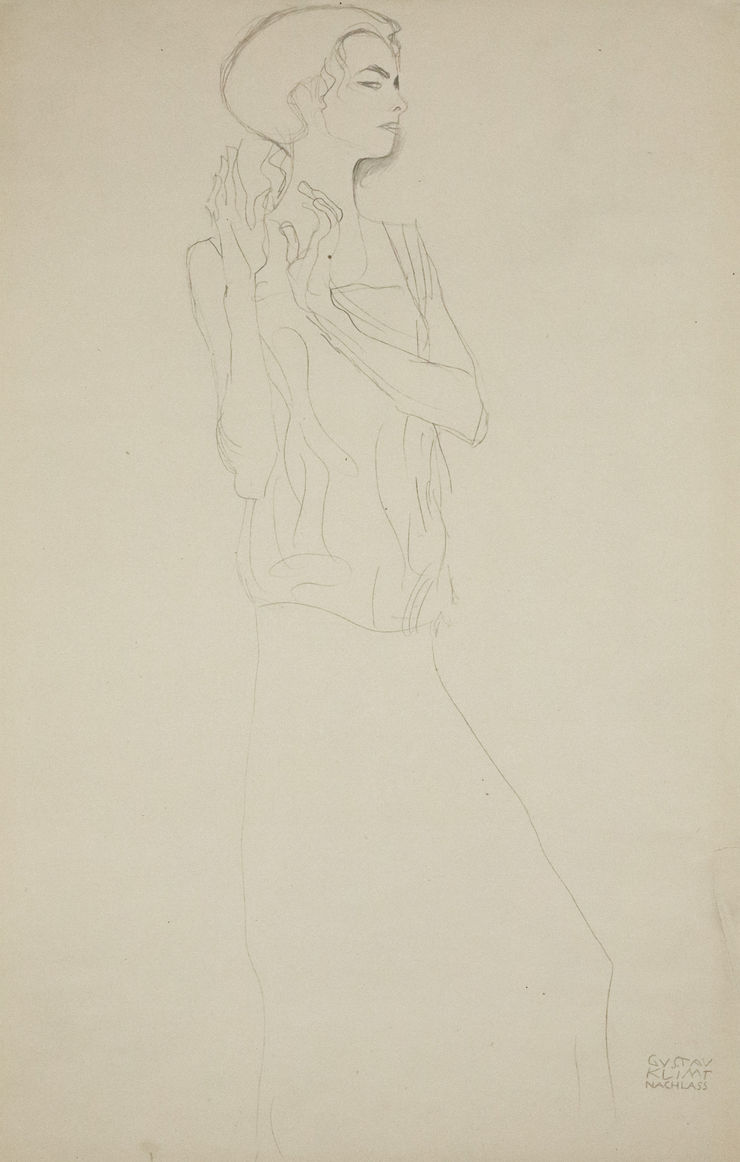
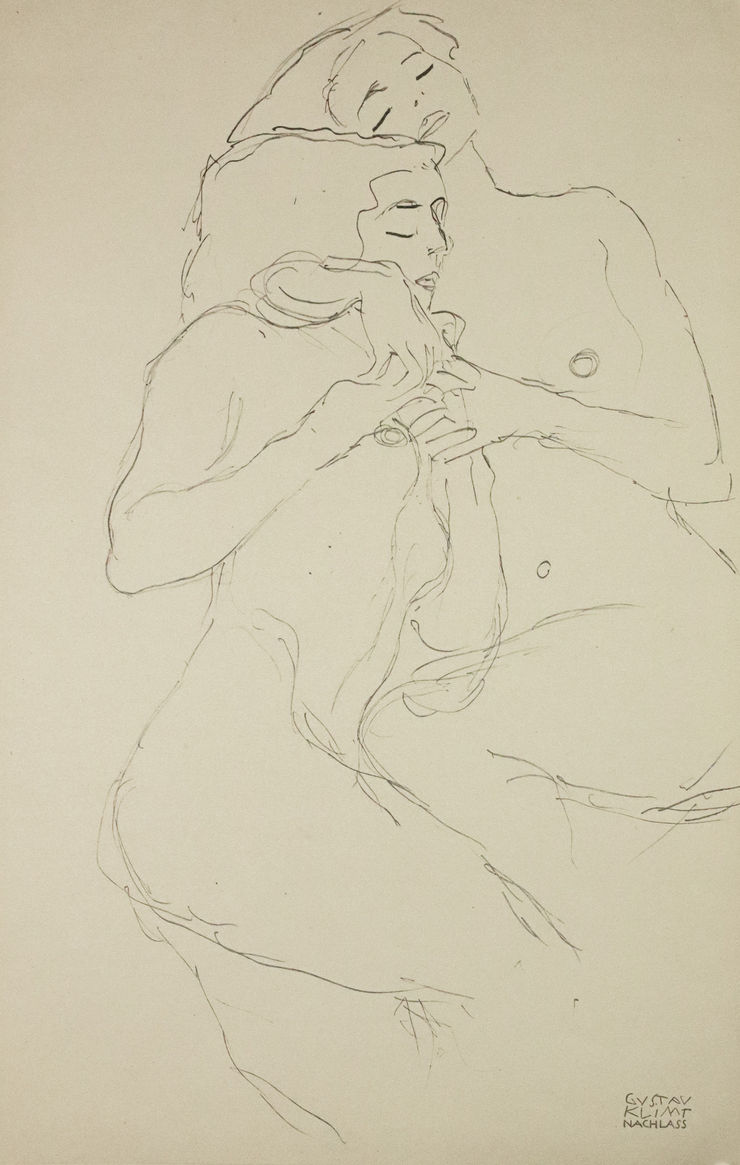
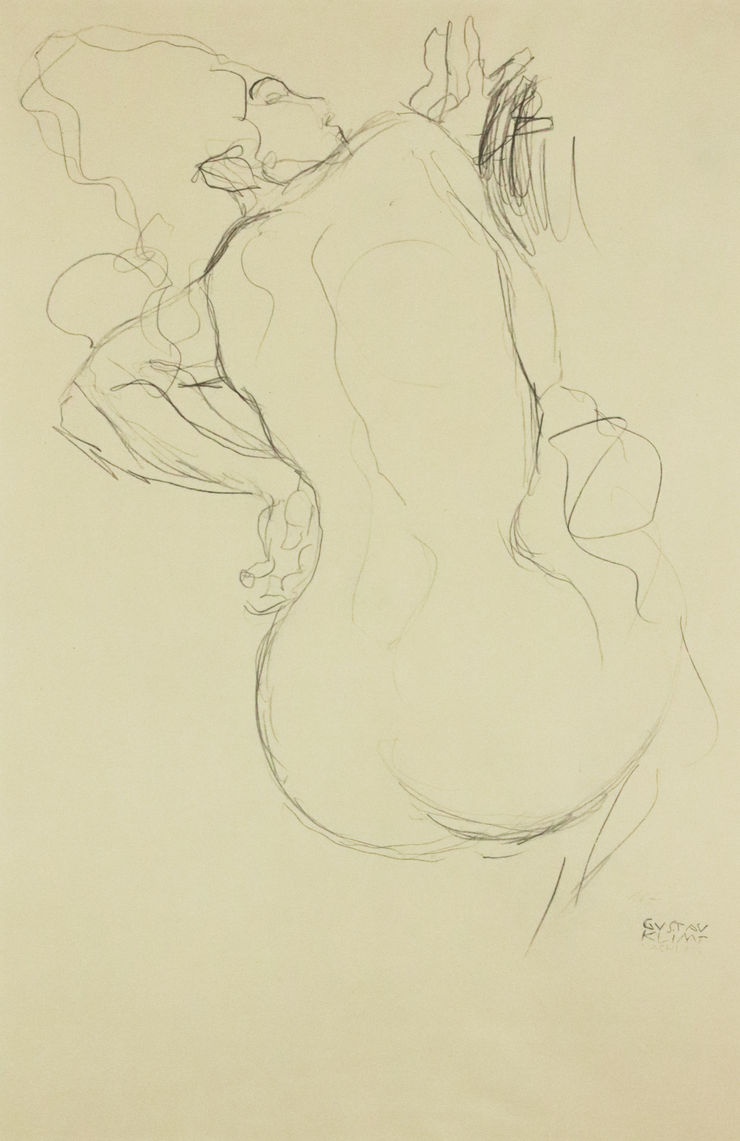
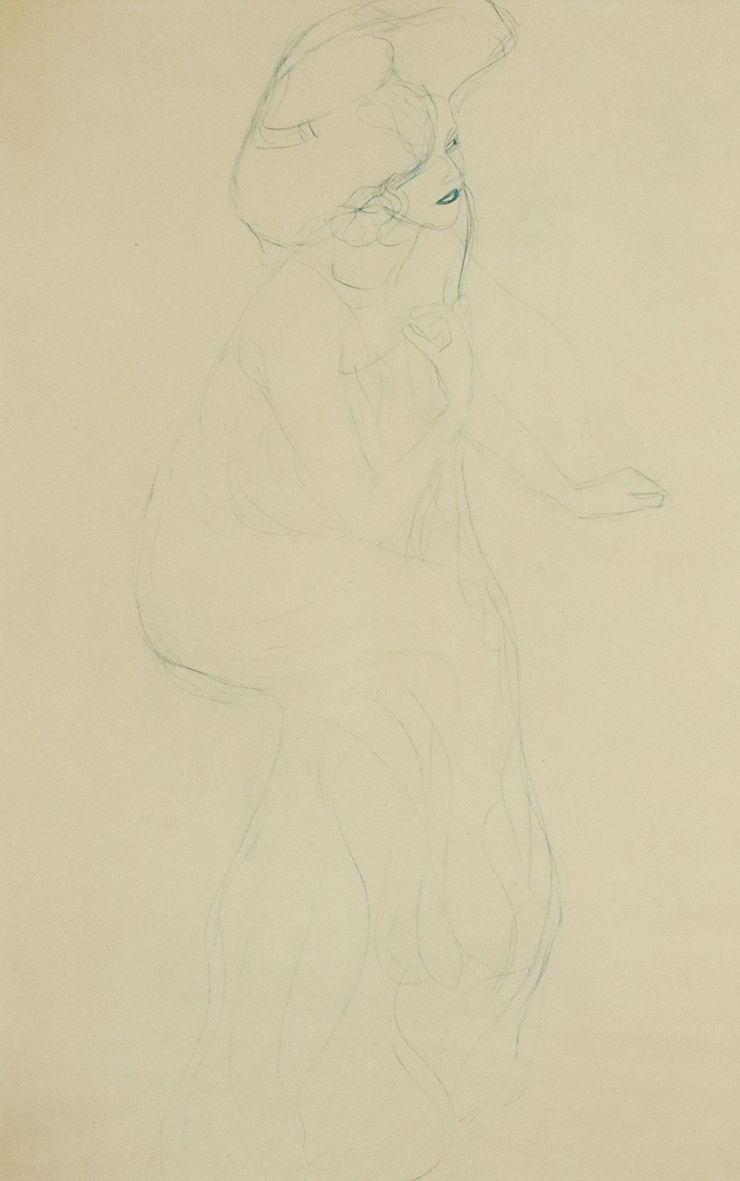
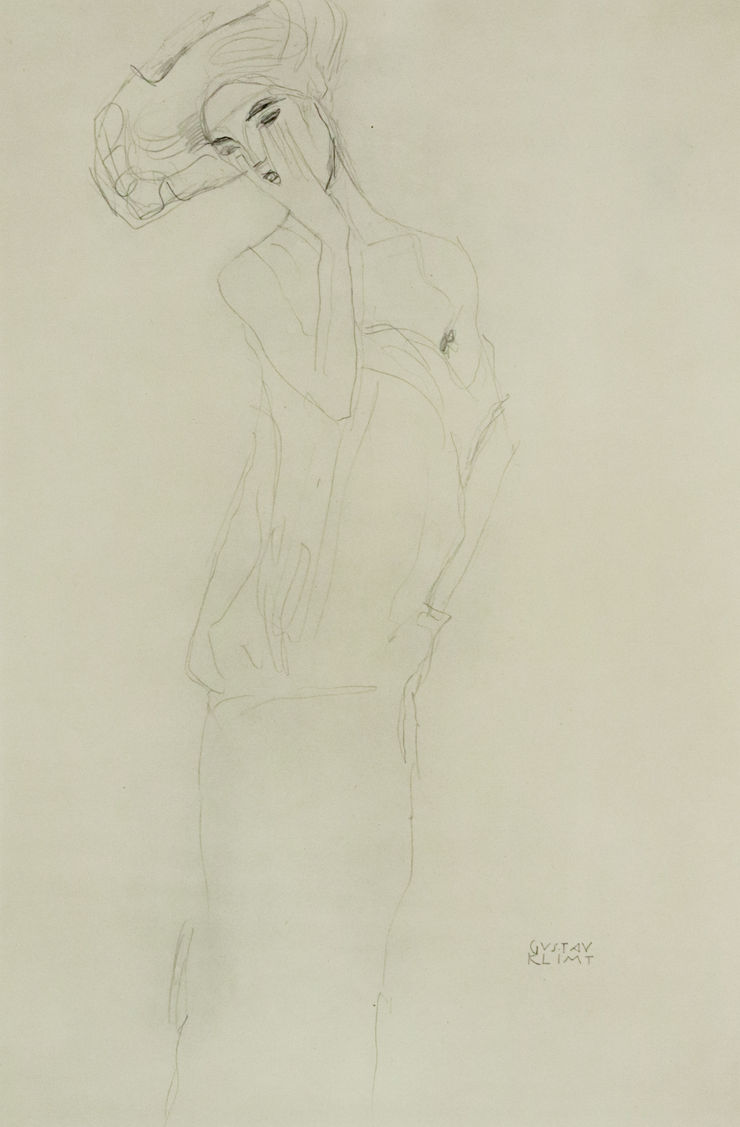
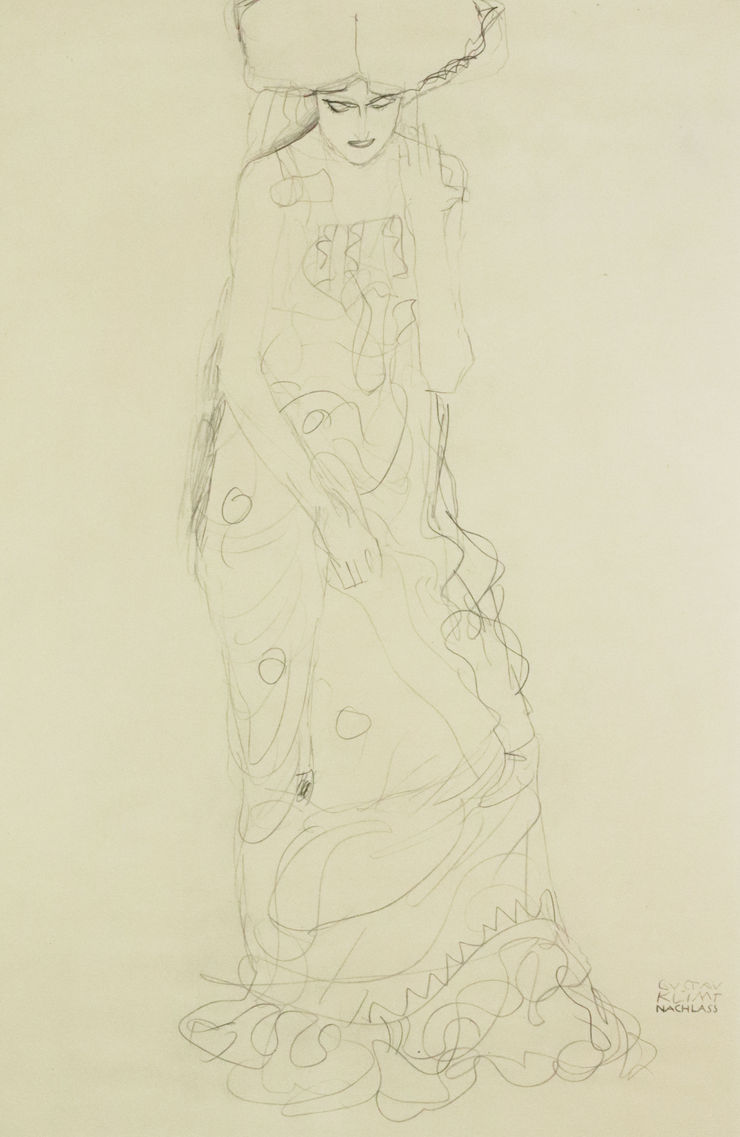
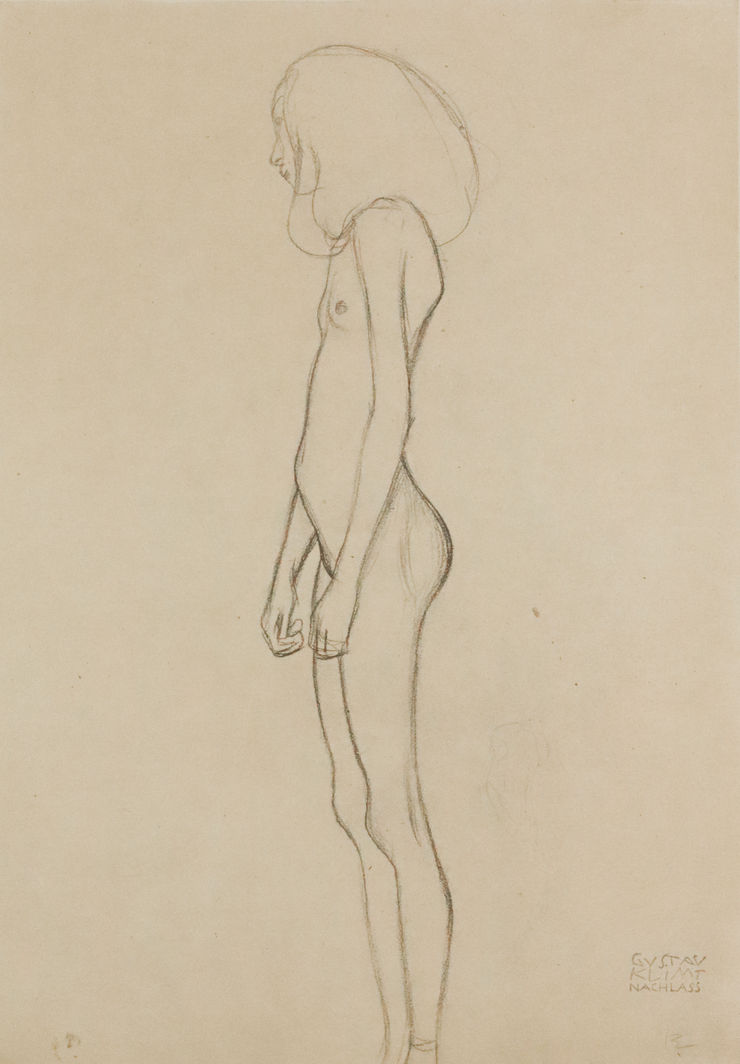
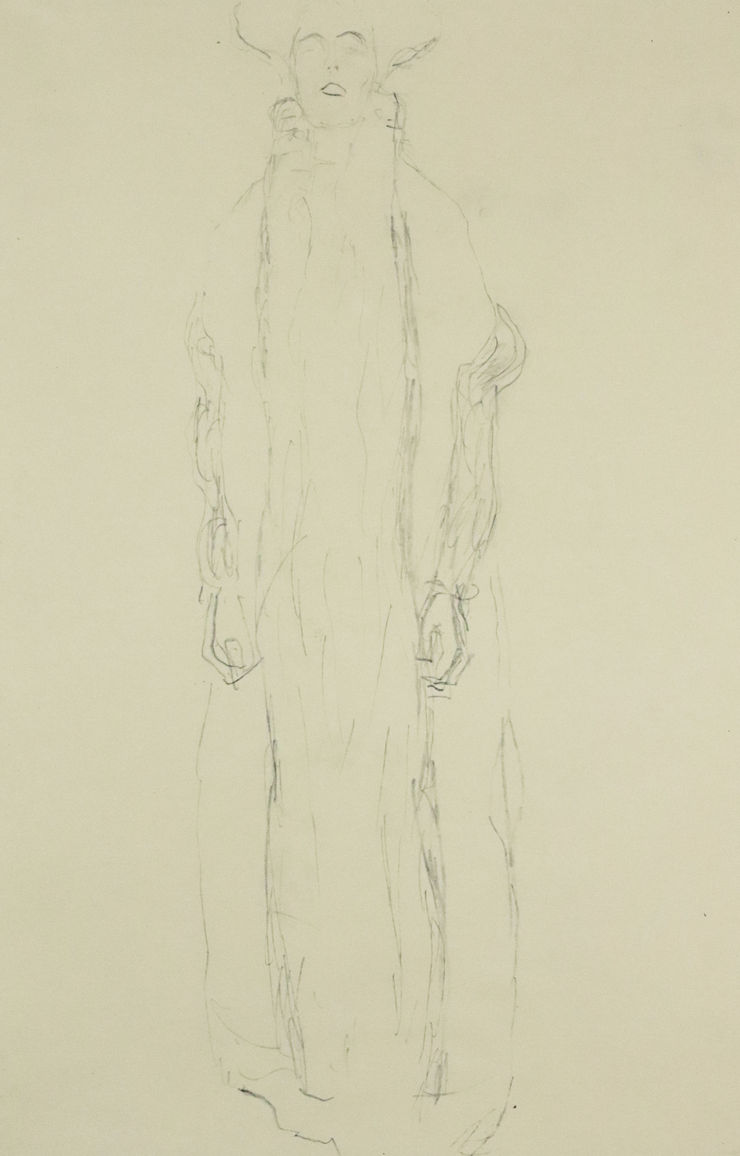
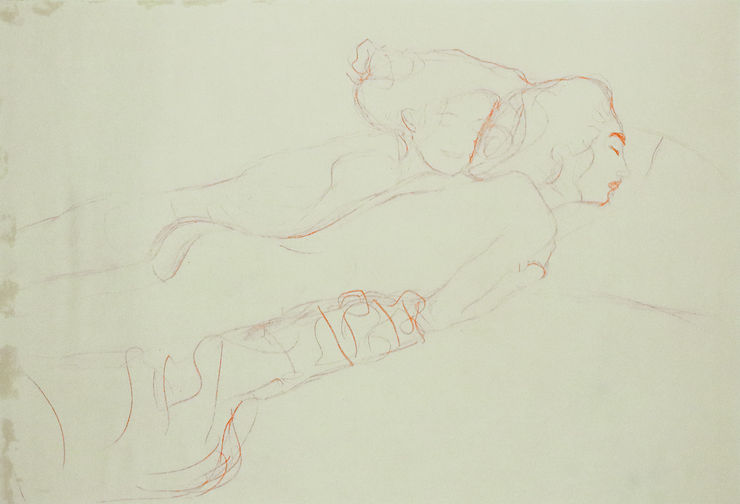
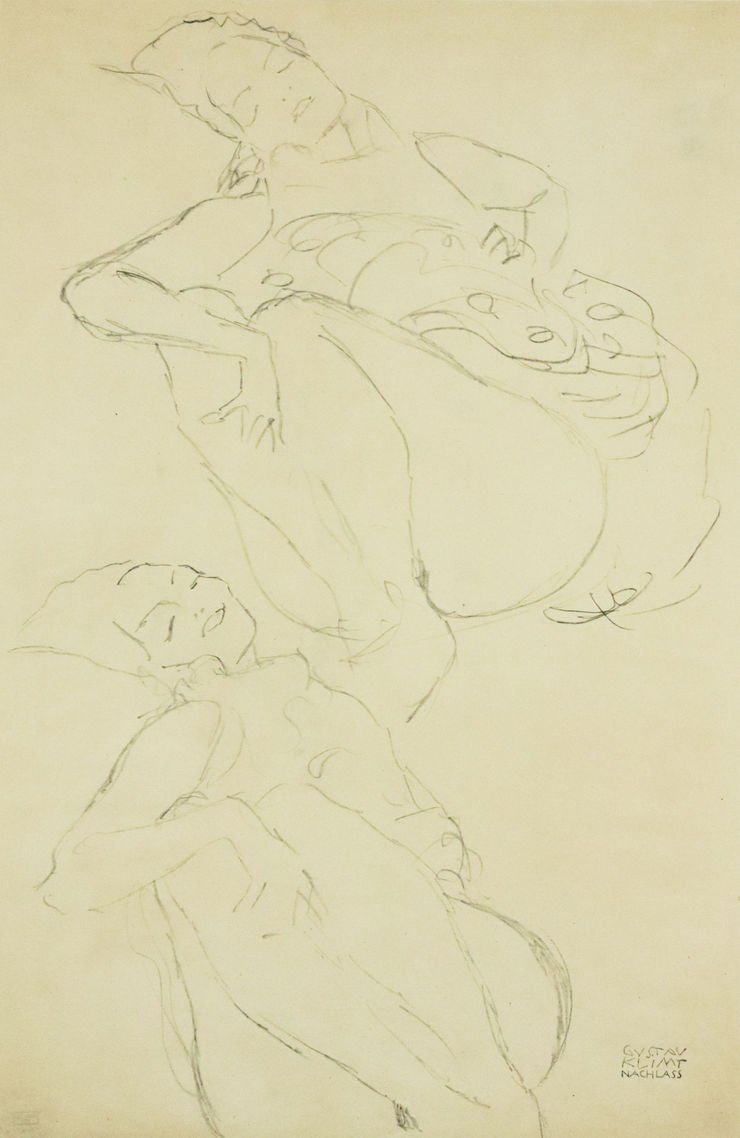
The drawings of Gustav Klimt have long been considered essential to understanding his achievement as an artist. Art historians have consistently emphasised that his work on paper is not peripheral, but central to his creative work. They reveal not only the origin of his paintings, but also the private arena in which his artistic language was first formed. In these works, Klimt’s line becomes a means of thinking—an instrument through which observation, emotion, obsession and imagination converge.
Klimt drew incessantly throughout his life, producing thousands of studies both as preparatory sketches and as independent works. Even some of the quickest and most minimal sketches are complete expressions in themselves and all the works were clearly sites of experimentation where Klimt explored gesture, posture, and emotional presence.
-
Collotypes
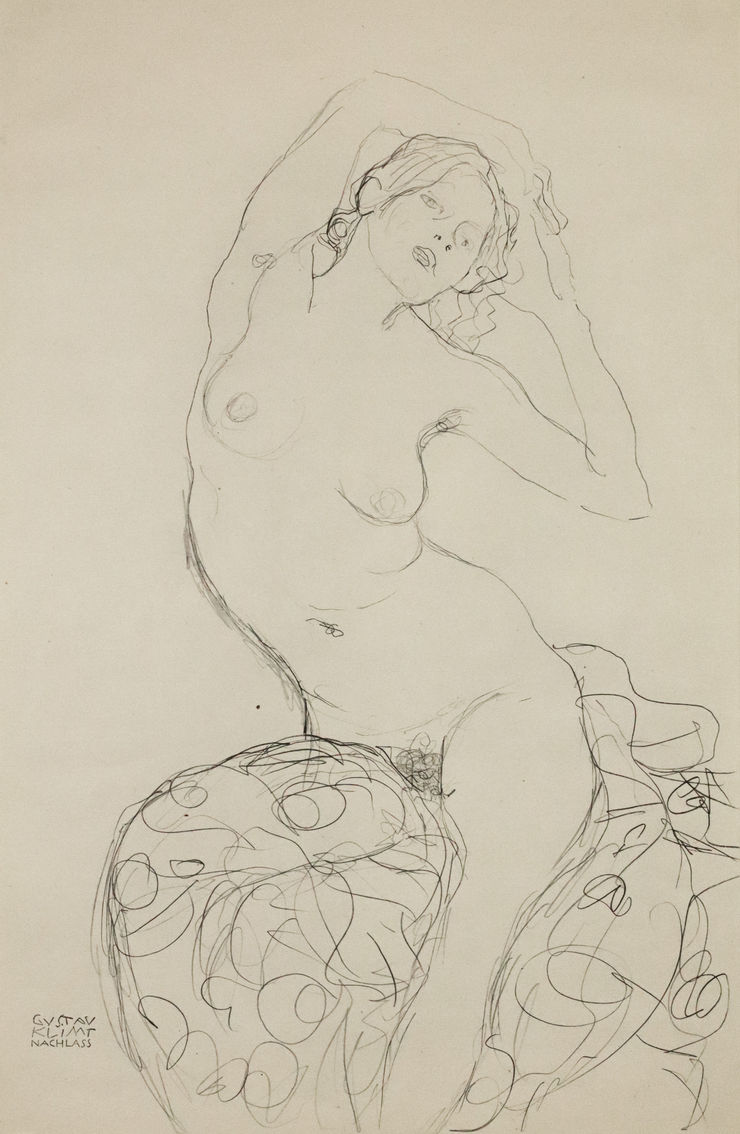
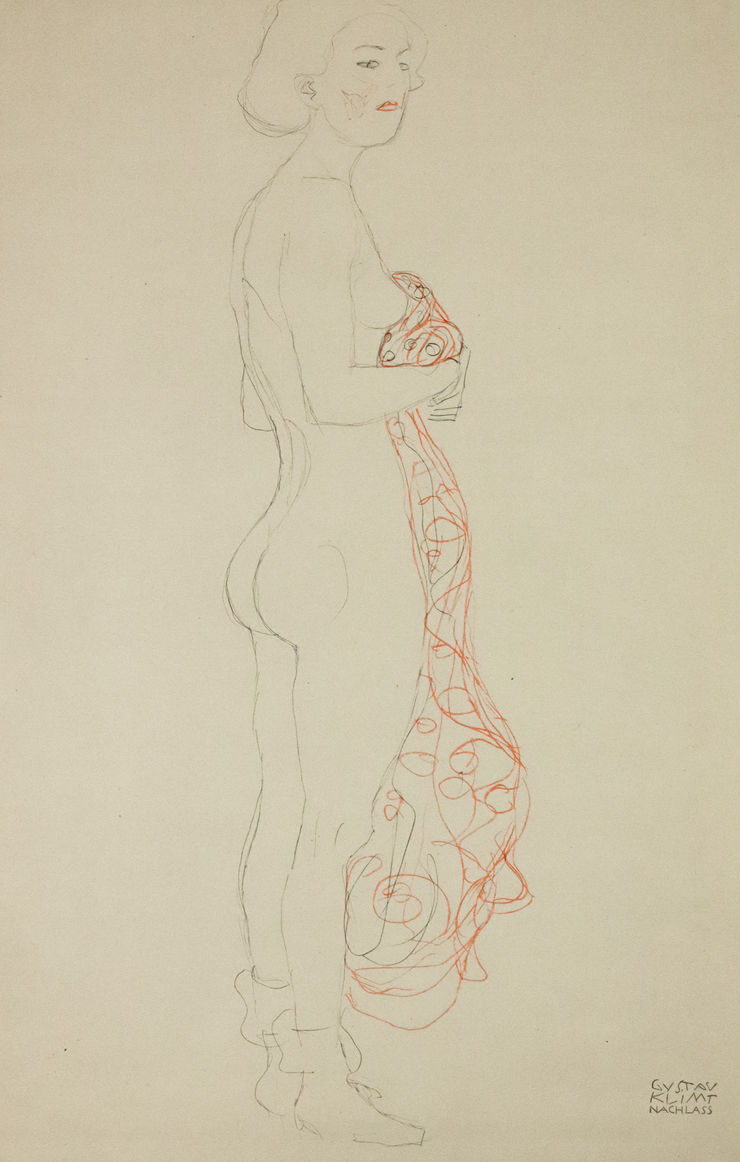
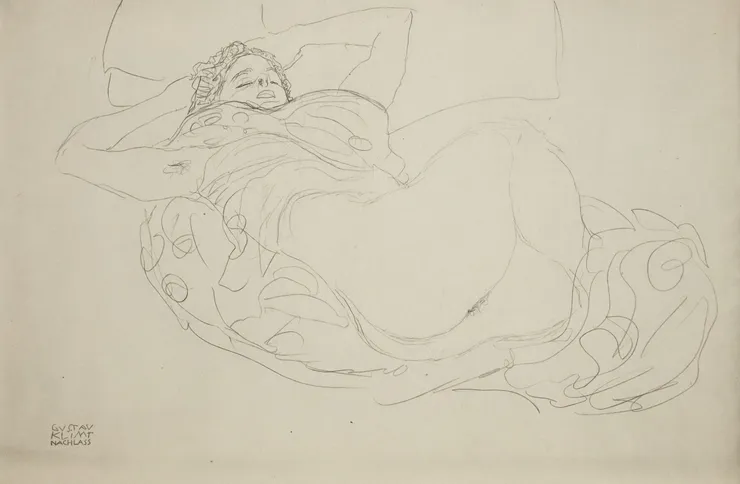
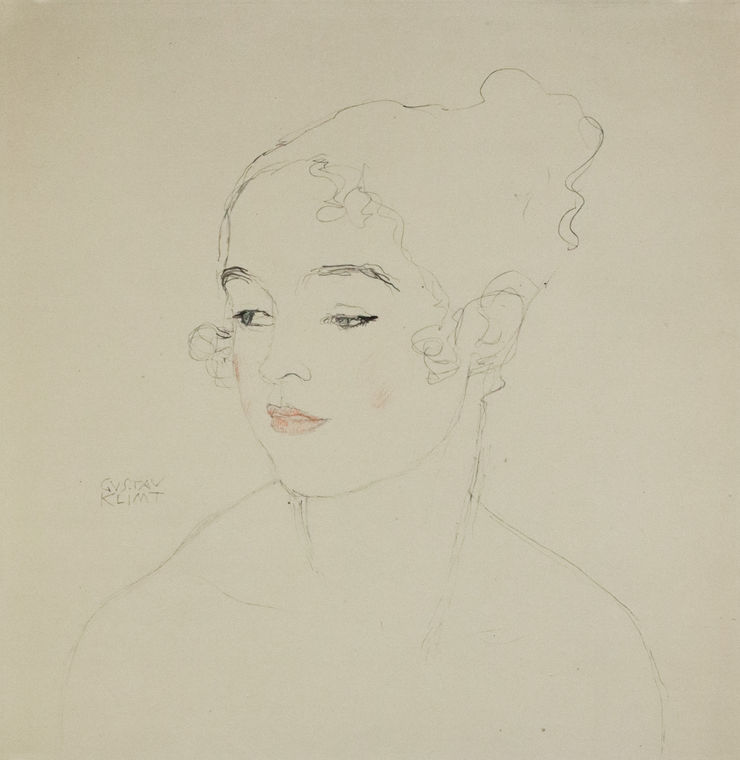
The first collection – a series of twenty-five collotypes in an edition of 500 was printed in 1919. The original pencil sketches, from which these collotypes were taken, were selected from August and Serena Lederer’s vast collection of Klimt’s works – a collection that was later seized by the Nazi’s in 1938 so many now only exist as these collotypes. All the works were printed posthumously, one year after Klimt’s death, by the Kunstanstalt Max Jaffé, a Viennese specialist in fine art collotypes. The complex collotype printing process perfectly rendered Klimt’s spontaneous drawing style. It is believed that the artist had some involvement with the production planning due to the meticulous nature of the printing and attention to detail. Klimt had overseen the production of the plates for Das Werk, published the preceding year, making sure each one was to his exact specifications, a level of quality carried through similarly in Twenty-Five drawings.
Collotype printing is a complex, labour-intensive process that has now been almost entirely replaced by lithography for its ease of use. Collotype is a dichromate-based photographic process and was invented in 1856. The gelatine plates required a very delicate preparation involving photographic images burnt onto the thin layer of gelatin which is then coated in ink and printed. The ink seeps into the gelatin allowing for microscopic levels of detail. Collotype plates are extremely fragile and so cannot be re-used, but the prints produced from the colloid ink were beautifully detailed, sincere impressions, and also very stable, so they had no chance of fading like other photographic processes of the time. -
-
 Gustav KlimtFemale Nude, Seated, 1919FramedSold
 -
Gustav KlimtFemale Nude, Standing, 1919FramedSold
-
Gustav KlimtFigurine, Standing, with Lace Bonnet, 1919FramedSold
-
Gustav KlimtHead Study (Early Chalk Drawing), 1919FramedSold
-
Gustav KlimtHead Study (pencil), 1919FramedSold
-
Gustav KlimtNude, Standing, with Cloth (tinted red), 1919Framed£2,600.00
-
Gustav KlimtPortrait Sketch (tinted in blue, red, and white), 1919Framed£2,600.00
-
Gustav KlimtPortrait Sketch: Lady with a Ruff (tinted red and white), 1919FramedSold
-
Gustav KlimtPortrait Sketch: Lady with Boa (tinted red and white), 1919FramedSold
-
Gustav KlimtReclining Female Nude (red pencil), 1919FramedSold
-
Gustav KlimtReclining Female Nude with a (red tinted) Neck Ruff, 1919FramedSold
-
Gustav KlimtReclining Female Nude, with Braid, 1919FramedSold
-
Gustav KlimtReclining, Female Half-nude, 1919Framed£2,600.00
-
Gustav KlimtReclining, Female Nude, 1919Framed£2,600.00
-
Gustav KlimtSketch for a Child's Portrait, 1919FramedSold
-
Gustav KlimtSketch for a Frieze in the Palais Stocklettes, Brussels, 1919FramedSold
-
Gustav KlimtSketch for the Water Snakes, 1919Framed£1,900.00
-
Gustav KlimtStudy of an Elderly Woman, 1919FramedSold
-
Gustav KlimtStudy of the Virgin, 1919Framed£1,900.00
-
Gustav KlimtStudy One of a Young Girl (red and blue pencil), 1919FramedSold
-
Gustav KlimtStudy: Half-length Portrait (red pencil), 1919FramedSold
-
Gustav KlimtStudy: On Danae (first draft), 1919FramedSold
-
Gustav KlimtTwo Female Nudes, Lying Down, 1919FramedSold
-
Gustav KlimtTwo Female Nudes, Seated, Embracing, 1919FramedSold
-
Gustav KlimtTwo Reclining Nudes (Woman and Young Girl), 1919FramedSold
-
-
-
Lithographs
The second folio we have is a series of lithographs printed in 1964. This series was selected by Alice Strobel, an academic who dedicated her studies to Klimt. She focused on works deemed most representative of Klimt’s flowing and quick style, spanning the breadth of his career. The scope of this collection offers numerous portraits of women from Viennese society as well as drawings featuring all the major themes in Klimt’s work such as love, eros and death.
-
-
Gustav KlimtFemale Nude in Back View, Facing Right, 1964FramedSold
-
Gustav KlimtFemale Nude, Prostrate on the Belly, with the Left Leg Pulled up., 1964FramedSold
-
Gustav KlimtFemale Nude, Raised in Suspense, with Left Arm Lifted, 1964FramedSold
-
Gustav KlimtFemale Semi-Nude in Movement Toward the Right, 1964FramedSold
-
Gustav KlimtHalf Length Portrait of a Lady in Three-Quarter Profile, Facing Right, 1964FramedSold
-
Gustav KlimtHalf-Length Portrait of a Lady with Fur Collar, in Three-Quarter Profile, Facing Left, 1964FramedSold
-
Gustav KlimtHead of a Woman in Three-Quarter Profile, Facing Left, 1964FramedSold
-
Gustav KlimtLady Reclining on a Lounge, 1964FramedSold
-
Gustav KlimtPortrait of a Lady in a Kimono, Facing Left, 1964FramedSold
-
Gustav KlimtPortrait of a Lady in Flowing Garment and Hat, Facing Right, 1964Framed£1,200.00
-
Gustav KlimtRecumbent Female Figure in Back View, Toward the Left, 1964FramedSold
-
Gustav KlimtRecumbent Female Nude, Toward the Left, 1964FramedSold
-
Gustav KlimtRecumbent Female Nude, Toward the Left, 1964FramedSold
-
Gustav KlimtSeated Female Semi-Nude, Facing Right, 1964FramedSold
-
Gustav KlimtSeated Girl, Facing Left, 1964FramedSold
-
Gustav KlimtSeated Lady in Long Plaited Garment and Hat, Facing Right, 1964Framed£1,200.00
-
Gustav KlimtSeated Lady, Facing Left, 1964Framed£1,200.00
-
Gustav KlimtStanding Female Figure in Front View, 1964FramedSold
-
Gustav KlimtStanding Female Figure in Front View, 1964FramedSold
-
Gustav KlimtStanding Female Nude in Profile, Facing Left, 1964FramedSold
-
Gustav KlimtStanding Lady in Full-Length Front View, 1964FramedSold
-
Gustav KlimtTwo Female Nudes in Prone Position, Toward the Right, 1964FramedSold
-
Gustav KlimtFemale Semi-nude in Prone Position, Toward the Right, 1964FramedSold
-
Gustav KlimtTwo Studies for a Female Semi-Nude in Reclining Position, 1964FramedSold
-
Gustav KlimtTwo Studies for a Female Semi-Nude in Recumbent Position, Toward the Left, 1964FramedSold
-
-
-