
Standing beside the expansive London from Richmond, Vincent began with the question: What is it that makes the Thames so compelling?
It is a subject we all feel we know. “It’s there. It’s just there,” Jason said. “It’s why London’s here and it's the heart of our city.”
Yet Dark River asks us to see the familiar river differently. This fourth and final Thames exhibition follows fourteen walks from Greenwich towards Thames Head: away from the city, through Hammersmith, Kew, Windsor, Oxford and beyond, until the river grows quieter, narrower and, eventually, disappears altogether.
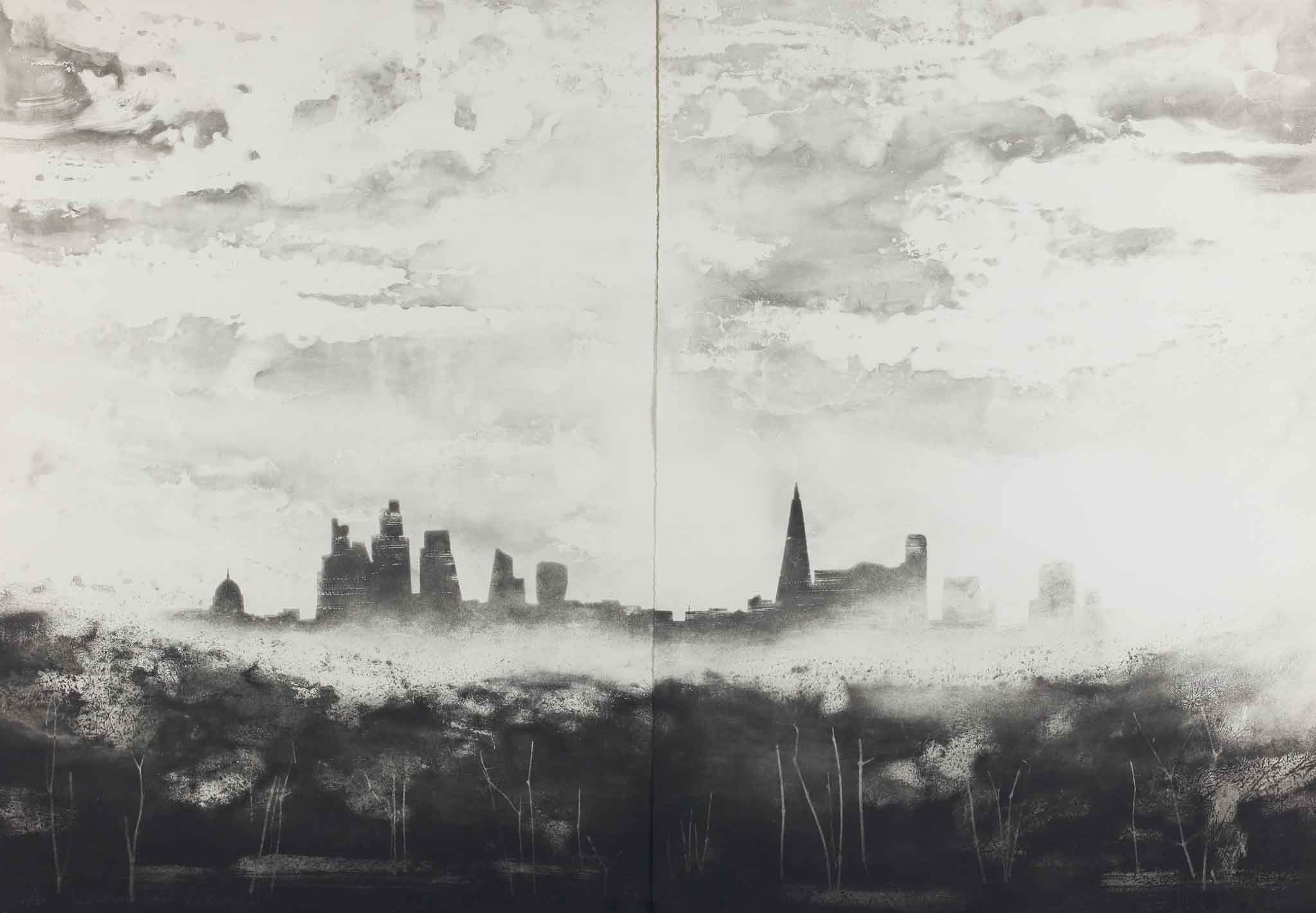
Jason Hicklin 'London From Richmond (Diptych)', 2026. etching
Every Show is About a Walk
For Jason, walking is not simply preparation for the work; it is its foundation.
“Every show is about a walk,” he explained. “That’s fundamental to what I do.” He walks through London wherever possible, and for this project followed the Thames upstream with a rucksack, sketchbooks and a small watercolour set. “I don’t need a map. I don’t need to ask anyone where to go. As long as I keep the river on my left or on my right and keep walking that way, I will get where I’m going.”
The sketches made along the way are quick, private notes rather than finished works: sometimes twenty seconds, sometimes five minutes. They record a shape, a shaft of light, the angle of a view or simply the feeling of a place. Back in the studio, Jason photocopies the sketchbooks, pins the pages to the wall and begins selecting the fragments which will become etchings.
“It’s a sense of light, of shape, perspective,” he said. “Just something to give me help when I get back to the studio.”
The first small etchings are made in the order he walked: Hammersmith, Barnes, Chiswick, Kew. “I need to get the first four etchings started before I go on to the next walk,” he explained. This way the working rhythm begins to mirror the rhythm of the journey itself.

Jason Hicklin 'The Thames, Wittenham Clumps', 2026, etching
The River Leads the Way
The route is not always easy. In some places, the Thames is generous; in others, it is hidden behind private gardens, difficult crossings or stretches that turn their back on the water altogether. Jason spoke warmly of the unexpected details that emerge only at a walking pace: ancient ferries, wooden bridges, dragonflies and butterflies, and countryside that feels a world away from London despite being only an hour by train.
“The river meanders, so you’re walking for ages and, as the crow flies, you’ve done about three miles. But you’ve been walking half a day.”
There were moments when cutting across country would have been simpler, but that would have “broken the walk”. “I had to follow the river – always.” Jason said. “I need to know I’ve done this walk properly.”
The commitment has made the project a record not of a prescribed itinerary, but of encounter and discovery. The locations were not all selected in advance. Some became important because of a view; others because of the memory attached to reaching them. At Lechlade, after a long day’s walking, the sight of the church spire meant he was nearly there. At Wittenham Clumps, Jason was drawn first to “a hill”, only later discovering its rich history and its importance to artists including Paul Nash.
“They become memories,” he said of the finished works. “To me, I’m documenting a walk.”

Jason Hicklin 'Lechlade-on-Thames (Diptych)', 2026, etching
From River to Light
Though the Thames supplies the route, the conversation revealed that water is not always the true subject. “The subject is an excuse for me to explore etching,” Jason said, adding that each project pushes him towards a fresh technical problem.
For Dark River, that problem was trees.
Jason’s earlier Thames works often moved through the city or towards the estuary, places defined by buildings, bridges and recognisable silhouettes. Going towards the source meant encountering foliage in all its complexity. “I was confronted with a lot of trees,” he recalled. “I had to find inventive ways of making the etching work, and making it feel like it’s my response to foliage.”

Jason Hicklin, 'The Thames, Athens, Eton', 2026, etching
The answer was not to render every branch or leaf. Instead, Jason found ways of making a landscape of shapes, tonal fields and negative space: inventive processes that transformed the challenge into a visual language of his own.
Throughout the conversation, Vincent returned to the extraordinary skies in the exhibition. “Actually, the subject of this isn’t the river, is it?” he asked. “It’s light.”
“Yes. Light.” Jason agreed.
He spoke of reading about clouds and making small etchings from their descriptions, gradually learning how weather and illumination could become a kind of theatre across the landscape. Water and sky exchange roles in these works: both reflections, both surfaces for light, both capable of dissolving the solidity of the world around them.
“I wanted to stretch that technical challenge as far as possible,” he said. “The sky and the light become a beautiful challenge.”
The Confidence To Do Less
That challenge is particularly present in the larger etchings, where forms sometimes dissolve towards abstraction. Jason described the freedom that came once the exhibition was taking shape: if an experimental work failed, the show could still go ahead. That gave him space to take risks, to allow paper, plate and process to do more of the work.
“It gave me quite a lot,” he said of one particularly spare etching. “It just fell into place quite well.”
Vincent identified a “confidence to do less” in these works, something Jason recognised when looking back at the darker, more densely worked London etchings of earlier years. “The idea of handling light in etching is really crucial,” Jason reflected. “I think that’s something I’ve learned — the importance, and how to handle it. It’s almost a lightness of touch.”
The exhibition also included watercolours, which Jason sees as close companions to the etchings. Both processes are built in layers; both require a willingness to stop at the right moment. “Don’t do anything if you’re not sure,” he said. “With a watercolour, it’s a shame to lose it.”
Some works begin with a wax-resist drawing made with a transparent candle. Only when watercolour is brushed over the paper does Jason see what has emerged: “Oh, I quite like that, that’s all right.”

Jason Hicklin, 'Kempsford', 2026, watercolour
A Full Stop... For Now
Dark River brings Jason to Thames Head, where the final stretch of the riverbed was dry enough to walk in. “The last mile of the walk, or even more, I would walk on the bed of the Thames,” he said. “I was walking in the Thames, because it was dry. And that was quite a nice way to finish the Thames walk.”
What began as a London project expanded gradually. “The first couple of shows, I thought I’d just work in London. But then I had the strong pull to bring it all together: I said ‘I need to go to the head, to the source and I need to go to where the river meets the sea.’” I had to complete the journey I’d started.
In following the river, he discovered a different England: the quietness and isolation he had associated with Ireland and Scotland, found instead in Gloucestershire and the Cotswolds. “I fell in love with the river, doing this walk.”
The final large etching in the show looks back towards London from Waterloo Bridge. Here the city is small beneath an immense sky. Jason wanted the image to carry the feeling of departure: “I wanted London to look desolate. I wanted it to have that sort of me moving away from it somehow.”
The skyline, he reflected, will not last forever. The river and sky will continue; London will alter, as it has done across every century. It is a quietly moving way to conclude this remarkable sequence of exhibitions — a farewell to a particular journey, though not necessarily to the Thames itself.
Is this the end of the project? “For now,” Jason said. “London’s changing so quickly, so it might be nice to revisit in a few years, when some of the skyline has changed again, and see what’s gone and what comes.”

Jason Hicklin, 'The Thames, The city from Waterloo Bridge (Hexaptych), 2026, etching