Eames Fine Art Gallery
58 Bermondsey Street, London SE1 3UD
When Barbara Hepworth visited St Ives in 1939 she was enthralled by the light, the shapes, the people and the sea. She commented that she had been "embraced by the land and seascape". She was so captivated that she moved her family and studio there in 1949.
She was not alone, St Ives has lured artists to it's cobbled streets, powerful coastlines and big skies for years. This exhibition celebrates some of the artists who have been inspired and worked there.
-
The Cornish coast has always attracted artists in search of good light, dramatic landscape and a simple way of life, but the light in St Ives is said to be unlike anywhere else. The town is situated on the west coast of Cornwall, facing out towards the Atlantic Ocean, benefitting from softer, more diffuse light than other parts of the British Isles. It is a changing, enigmatic light that continues to attract artists through time.
Drawn to the Cornish landscape and to each other, many St Ives artists shared a commitment to abstraction. The region also became known for printmaking, with many painters producing exceptional etchings, lithographs, linocuts, and screenprints. Collaborations between artists and printmakers flourished-such as Barbara Hepworth with Stanley Jones, and Terry Frost with Hugh Stoneman.
St Ives remains a vibrant artistic centre. Since the opening of Tate St Ives in 1993, it has continued to attract artists and collectors from around the world. Eames Fine Art is proud to work with the studios and estates of master printmakers and artists who have all at some time been charmed by St Ives and have created beautiful work there.
-
Barbara Hepworth (1903-1975)
Barbara Hepworth was a central figure in the modernist artistic community of St Ives, where she lived and worked for much of her life. Deeply involved in the town’s post-war cultural resurgence, she helped establish St Ives as an international hub for modern art. Her contribution to public life and cultural renewal in Britain was epitomised by her two major commissions for the 1951 Festival of Britain, and her legacy continues to shape the identity of St Ives as a place of creative innovation.Born in Wakefield, Yorkshire, Hepworth trained in sculpture at Leeds School of Art (1920–21) and the Royal College of Art (1921–24). In the early 1930s, she emerged as a leading voice in abstraction, pioneering the technique of piercing the sculptural block and experimenting with collage, photograms and printmaking. Her later works on paper reveal a deep affinity for form and mark-making. Hepworth's international standing was confirmed with the Grand Prix at the 1959 São Paolo Bienal, as well as numerous honours including a CBE (1958), DBE (1965), and the installation of her bronze Single Form outside the United Nations headquarters in New York in 1964. -
Ben Nicholson (1894-1982)
Ben Nicholson played a vital role in establishing St Ives as a centre of British modernism. He lived and worked in the town with Barbara Hepworth until 1958, and their creative exchange helped shape a significant period in both their practices. Inspired by the Cornish landscape and the dynamic artistic community, Nicholson’s time in St Ives marked a key phase in his career, one of intense experimentation and growing international recognition.Born into a family of artists, Nicholson was the son of painters William Nicholson and Mabel Pryde. He was a member of influential groups such as the Seven and Five Society and Unit One, placing him at the heart of Britain’s modernist movement. Known for his abstract geometric paintings, reliefs and prints, Nicholson combined formal clarity with a poetic sense of place, drawing inspiration from both British and European artists, including Piet Mondrian and Pablo Picasso. He won the first Guggenheim International Painting Prize in 1956, the international painting prize at the São Paolo Bienal in 1957, and was awarded the Order of Merit in 1968. -
-
 Ben NicholsonBirds Eye, 1966£8,500.00
 -
Ben NicholsonSt. Ives from Trezion, 1967£15,500.00
-
Ben NicholsonTwo Turkish Forms, 1968£3,800.00
-
Ben NicholsonAegean, 1968Sold
-
Ben NicholsonTurkish Sundial and Column, 1968£4,200.00
-
Ben NicholsonAegean II, 1968£4,200.00
-
Ben NicholsonCurled Turkish Form, 1968£4,200.00
-
Ben NicholsonParos II, 1968Sold
-
Ben NicholsonColumn and Tree, 1968£4,200.00
-
Ben NicholsonTurkish Forms with Leaf, 1968£4,200.00
-
Ben NicholsonPatmos Monastery, 1968Sold
-
Ben NicholsonTurkish Sundial and Tree, 1968£4,200.00
-
-
Sir Terry Frost (1915-2003)
Terry Frost’s move to St Ives in the late 1940s marked a turning point in his artistic career. Immersed in the thriving post-war art scene, he formed lasting relationships with artists such as Barbara Hepworth and Ben Nicholson, and drew deep inspiration from the Cornish landscape. St Ives became central to his development as an abstract artist, with its light, forms and rhythms influencing the dynamic energy of his work.Born in Leamington Spa, Frost served in the British Army as a Commando during the Second World War before studying at the Camberwell School of Art. He transitioned from representational painting to abstraction, developing a distinctive visual language of bold colour, geometric forms and joyful movement. Alongside his paintings, he was a prolific printmaker, embracing screen printing and etching in the 1960s with the same inventive spirit. Frost exhibited widely, taught at the University of Reading, and was awarded a Knighthood in 1998.His work is held in most major British institutions, notably in both Tate Britain and Tate St Ives, as well as having been displayed internationally, most recently being a major exhibition at The Rothko Centre in Latvia in 2021. -
Alan Davie (1920-2014)
Alan Davie was closely linked to the St Ives art scene in the post-war years, sharing its spirit of experimentation and abstraction. Though not based there permanently, his visits brought him into conversation with artists like Ben Nicholson, and the town’s energy aligned with his improvisational, intuitive approach.Born in Grangemouth in 1920, Davie studied at Edinburgh College of Art and pursued jazz and jewellery-making alongside painting. Influenced by Surrealism, Zen Buddhism and ancient cultures, his bold, symbolic works embraced spontaneity and gesture. In 1948, Peggy Guggenheim acquired his work in Venice, launching his international career. He exhibited widely, with works now in Tate, MoMA and the Guggenheim, and was appointed CBE in 1972. -
Patrick Heron (1920-1999)
Patrick Heron was a central figure in the St Ives art community, living and working at Eagles Nest in Zennor from 1956. The Cornish light and landscape profoundly shaped his vibrant explorations of colour and form, and he became one of the most influential voices in post-war British abstraction.Born in Leeds in 1920, Heron was inspired early on by Cézanne, Matisse and Braque, eventually moving from figuration to bold, expressive abstraction. His signature works—‘stripe’ paintings and later ‘wobbly hard-edge’ compositions—reflect his belief in the emotional power of colour. A leading art critic as well as a painter, Heron also contributed to the design of a stained-glass window for Tate St Ives. His work is held in major collections including Tate, MoMA and the V&A. -
Trevor Price (b. 1966)
Trevor Price is a Cornwall-born printmaker whose finely detailed drypoint and relief prints often explore intimate human connections and coastal landscapes. Trained at Falmouth and Winchester Schools of Art, his work is deeply influenced by the textures and forms of his native environment.
Known for his distinctive linework and use of texture, Price’s prints frequently depict entwined figures and interior spaces.
Elected to the Royal Society of Painter-Printmakers in 1994, he served as its Vice President from 2013 to 2018. His work is held in major public collections, including the Victoria and Albert Museum and the Ashmolean Museum, and in 2020 he was commissioned by the National Academy of Painting in China.
-
John Hoyland (1934-2011)
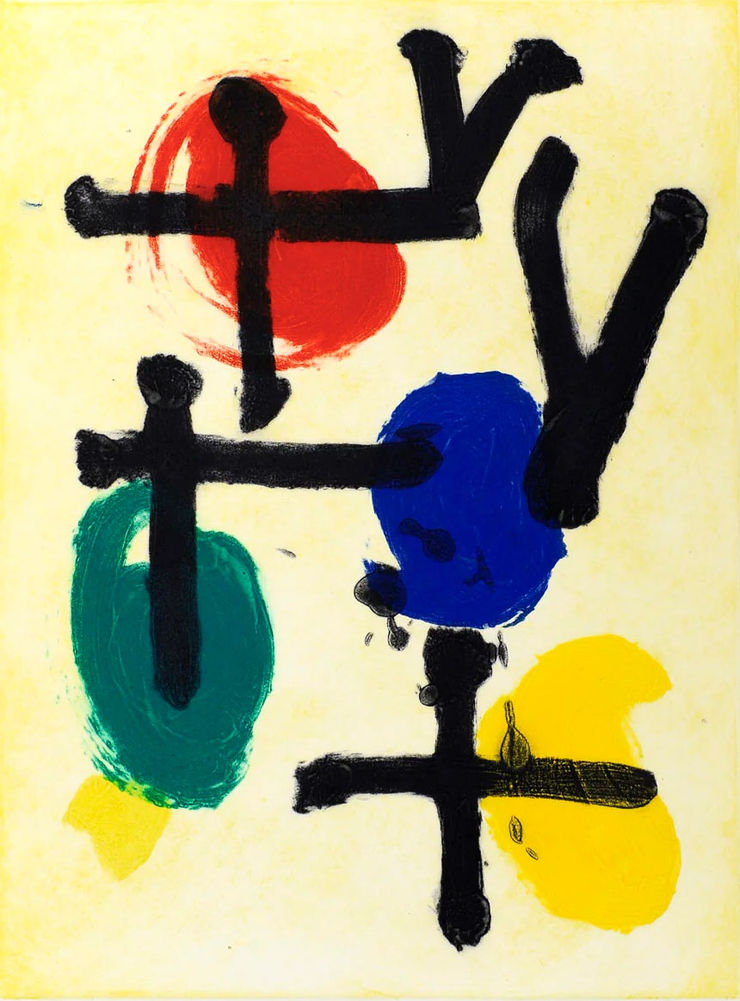
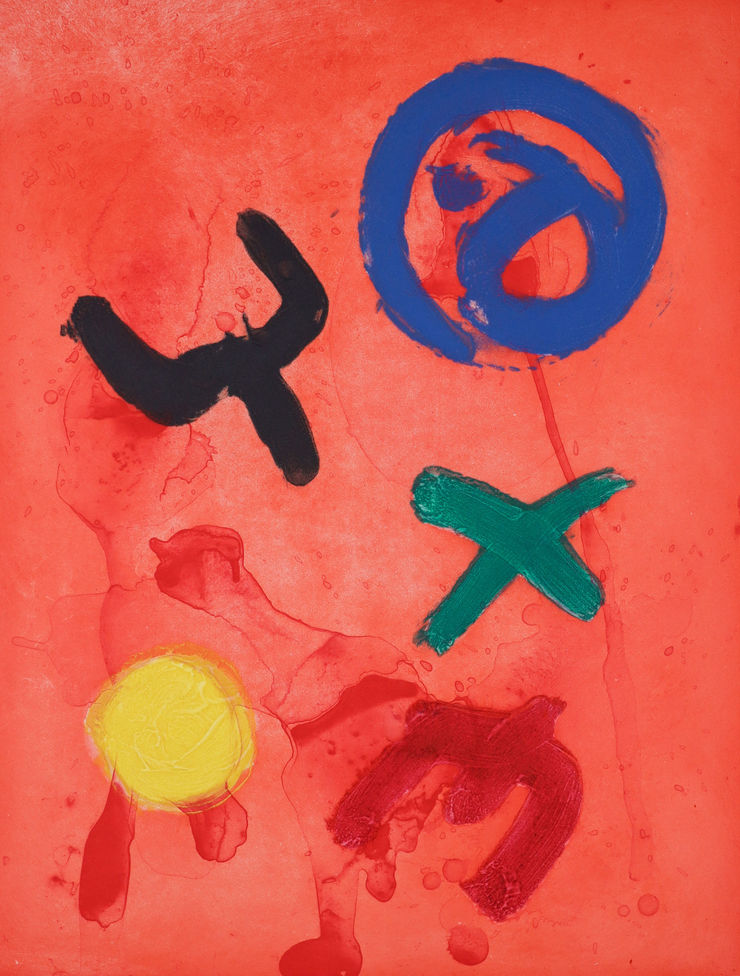
John Hoyland was one of Britain’s leading abstract painters, celebrated for his fearless use of colour, scale, and gestural form. Though not based in St Ives, Hoyland’s connection to the town was cemented through his collaboration with master printmaker Hugh Stoneman, who invited him to Cornwall in the 1990s. It was in Stoneman’s studio that Hoyland created a remarkable series of prints that distilled the expressive power of his painting into print form.
The works Flying Wild, Secret Summer, and Endless Poem exemplify this dynamic collaboration. Printed in St Ives, they combine vivid colour fields with layered mark-making, revealing Hoyland’s intuitive response to both process and place. These prints are not just reproductions of painted ideas but standalone works that reflect the freedom and intensity of his visual language.
-
Victor Pasmore (1906-1998)
Victor Pasmore (1908–1998) was a leading figure in British abstraction and a pivotal force in the development of post-war modernism. Though not a permanent resident of St Ives, Pasmore was closely connected to the movement that grew from the town's vibrant artistic community. His transition from figurative painting to pure abstraction in the late 1940s aligned with the direction being taken by artists in Cornwall, such as Ben Nicholson and Barbara Hepworth, whose embrace of geometry and spatial exploration mirrored his own evolving style.
Pasmore’s contribution to British abstraction resonated strongly with the principles championed in St Ives - particularly the synthesis of natural inspiration with formal innovation. While his most celebrated works emerged from his involvement with the Independent Group and his architectural collaborations, his visual language shares a clear kinship with the reductive, balanced compositions associated with St Ives modernism. His presence in the wider discourse helped to solidify the broader national and international importance of the St Ives movement.
-
IAN MCKEEVER (1946)
Like Pasmore, McKeever was never a resident in St Ives, but he moved to Dorset in 1990 and visited the Cornish coast regularly. He also collaborated closely with master printmaker Hugh Stoneman.
The style of McKeever's work changed with his move south - the landscapes inspired a softer style of billowing veils and dramatic spatial effects that further demonstrated his interest in contrasts and tone.
McKeever’s work can be found in many of the world's leading galleries and collections: The British Museum, The Government Art Collection, and The Tate Gallery in London and St Ives.
-
HENRY MOORE (1898 - 1986)
Henry Spencer Moore was born on July 30 1898 in Castleford, Yorkshire. In 1921 he won a Royal Exhibition Scholarship to study sculpture at the Royal Academy of Art in London. He was appointed Instructor of Sculpture at the Royal Academy in 1924. A Royal Academy travelling scholarship allowed Moore to visit Italy in 1925 where he saw the frescoes of Giotto and Masaccio and the late sculpture of Michelangelo. Moore’s first solo show of sculpture was held at the Warren Gallery, London, in 1928.As a close friend of Barbara Hepworth, Ben Nicholson and the critic Herbert Read, Moore undertook frequent trips to St Ives throughout his lifetime. Alongside his influence on British Modernism Moore was also an important force in the English surrealist movement, although he was not entirely committed to its doctrines. In 1940 Moore was appointed an official war artist and was commissioned by the War Artists Advisory Committee to execute drawings of life in underground bomb shelters. His first retrospective took place at Temple Newsam, Leeds in 1941, and he was given his first major retrospective abroad by the Museum of Modern Art, New York in 1946. He won the International Prize for Sculpture at the Venice Biennale of 1948.In 1963 Moore was awarded the British Order of Merit. In 1978 an exhibition of his work organised by the Arts Council of Great Britain was held at the Serpentine in London. -
William Scott (1913-1989)
William Scott was closely connected to the St Ives artistic community, exhibiting there regularly and maintaining friendships with key figures such as Ben Nicholson and Barbara Hepworth. Though not a permanent resident, he was part of the wider circle of artists drawn to the region’s creative energy in the post-war period. His association with St Ives placed him within the broader context of British modernism, where abstraction, landscape and still life converged in innovative ways.Born in Greenock, Scotland in 1913 and raised in Northern Ireland, Scott trained at the Royal Academy Schools in London. He is best known for his still lifes and abstract compositions, which merged everyday forms—jugs, plates, tables—with a restrained and rhythmic abstraction. His work balanced formal clarity with a sensual response to material and space. Internationally recognised,Retrospectives of Scott’s work have been held at the Tate Gallery and the Irish Museum of Modern Art in Dublin.. -